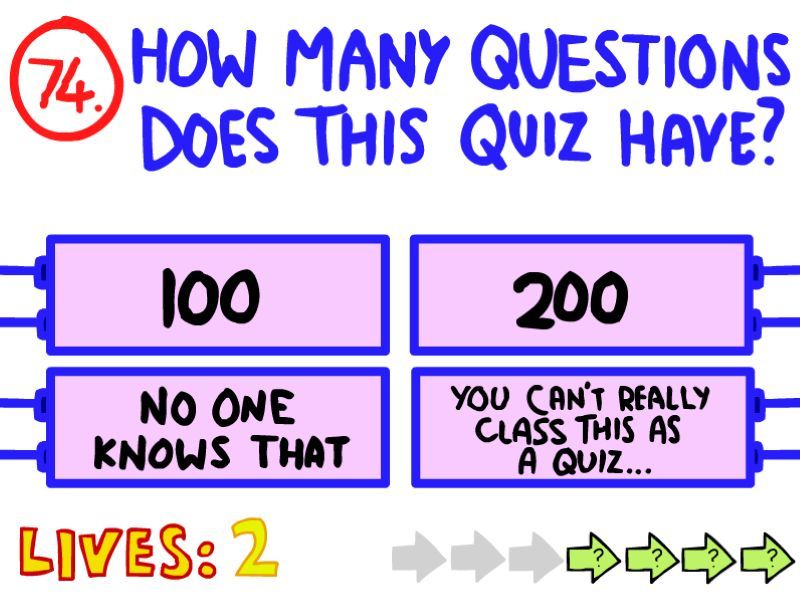
The Impossible Quiz has 110 questions in one run, with limited lives, skips, and timed bomb questions.
People argue about the number because portal listings and casual memory often round it to “about 100” or mix it up with sequels, but the original game has 110.
It stays difficult because “answers” can be puns or hidden clicks, so you must read carefully, test the screen, manage skips like emergencies, and stay calm through the run.
When The Impossible Quiz feels frustrating, play a few quick matches of A Small World Cup to reset your focus, then return calmer and more precise.
Read the full guide below to learn How many questions on the Impossible Quiz and how to reach the final question faster.
There are 110 questions, and you must clear them in a single run while managing limited lives, timed bomb questions, and scarce skips.
In The Impossible Quiz, the count is part of the difficulty curve.
You start with playful trick questions that teach you to mistrust obvious answers. As you progress, the quiz stacks mechanics on top of that: time pressure, mouse tricks, hidden clickable areas, and questions that punish impatience.
By the time you reach the late game, the challenge becomes memory plus execution. You are no longer solving in isolation. You are managing your run.
The 110 questions include everything the game throws at you, such as standard multiple choice prompts, interactive puzzles where you must click or drag something on the screen, and bomb questions that force you to respond before a timer expires.
Most confusion comes from platform differences and casual retellings.
Some players remember the quiz as “about a hundred questions” because few people reach the end on the first serious attempt.
Others mix it up with sequels or spin offs that have different totals. But for the original Impossible Quiz, the number you should quote in guides, summaries, and SEO pages is still 110.
If your goal is to answer search intent cleanly, lead with the exact number early, then explain what makes those questions feel longer than they are.
The game stays engaging because it changes what “answering” means.
Sometimes the correct option is a pun. Sometimes it is a visual joke. Sometimes it is not one of the four choices at all, because you must click the question text, the background, a tiny object, or an invisible hitbox.
In other moments, the quiz tests your discipline by daring you to overthink when the right move is to do nothing.
This shifting rule set is why the 110 question run feels intense. You are constantly switching between logic, observation, and mechanical control.
If you want to progress farther without looking up solutions, focus on repeatable habits.
Read the question twice, slowly, and treat every word as intentional. Many traps are hidden in phrasing.
Scan the full screen before you click an answer. If something looks like a button, a label, a cursor target, or a draggable object, test it.
Do not assume the answers are the only interactive elements. The quiz often rewards clicking the question itself or unrelated items.
When you hit a timed bomb question, prioritize the fastest safe action. Speed matters more than elegance.
If you are playing in a browser, keep your cursor control steady. Small, careful movement prevents misclicks during tricky interaction questions.
Skips exist to help you bypass certain questions, but they are also a resource management problem. Many players waste skips early to avoid frustration, then discover the late game demands smarter planning.
A strong rule is to treat skips as emergency tools. Save them for moments where the time pressure is too high, or where repeated attempts are draining your lives. If a question is confusing but not timed, it is often better to experiment rather than skip, because experimentation teaches you the quiz’s logic.
The Impossible Quiz is closer to a pattern recognition game than a knowledge test.
You win by learning its “language” and staying calm. If you rush, you misread. If you panic, you misclick. If you treat each failure as data, you improve quickly.
A simple mental model is this: every wrong answer is not a penalty alone, it is information that reduces the chance you repeat the same mistake later in the run.
If you feel stuck repeating the same section, take a short reset with A Small World Cup. It is a compact, physics driven soccer game that shifts your brain from word puzzles to timing and control, which can reduce frustration fast.
To play A Small World Cup effectively, keep your touches simple, aim for controlled shots rather than full power swings, and focus on positioning before you shoot. After a few quick matches, return to The Impossible Quiz with a calmer pace and better attention to detail, which is exactly what the trick questions punish most when you are tilted.
There are 110 questions in the original Impossible Quiz.
Yes, the classic structure is a continuous run, so consistency matters as much as problem solving.
You typically get three lives, and wrong answers cost a life, so careful testing is important.
Yes. Some questions include bomb timers, which force quick decisions and punish hesitation.
Yes, but using them early can backfire. Save skips for high pressure moments, especially timed sections.
Not really. It is mostly about wordplay, visual tricks, interaction surprises, and learning the game’s logic.
So, How many questions on the Impossible Quiz? The answer is 110, and the real challenge is surviving that full stretch with limited mistakes and steady focus.
Treat each failure as a clue, manage your skips like a resource, and when frustration peaks, reset your brain with a quick session of A Small World Cup before you dive back into the madness.